Main course · Chinese home cooking
Scallion Oil Noodles: One Jar of Oil, Two Weeks of Dinners
葱油拌面:一罐葱油,两周晚饭
The Shanghai classic built entirely on patience-fried scallion oil. Fry a jar's worth once, keep it two weeks, and dinner becomes boiled noodles tossed in sauce — five minutes, every time.
- Total
- 25 min
- Hands-on
- 5 min
- Yield
- Makes 1 jar of oil, 4 servings
The first fifteen minutes of frying are unattended; the last five need you at the pan.前十五分钟炸葱不用守着,最后五分钟要站在锅边。
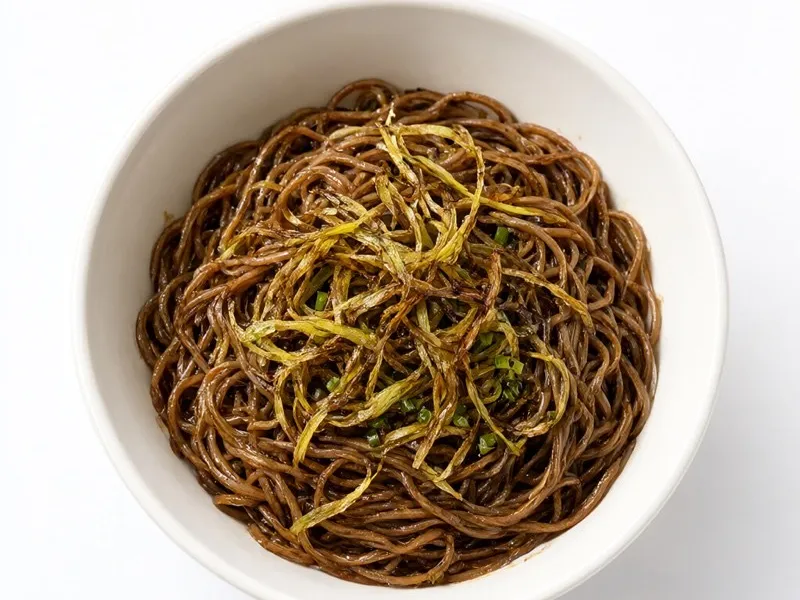
Ingredients 食材
- 1 bunch scallions, cut into 5 cm lengths, plus 120 ml neutral oil小葱一把切 5 厘米段,加 120 毫升无味植物油
- 200 g thin wheat noodles细面 200 克
- 3 tbsp light soy, 1 tbsp dark soy, 1 tbsp sugar生抽 3 勺、老抽 1 勺、糖 1 勺
What to buy 怎么买
Thin dried wheat noodles (somen or Shanghai noodles). Look for thin dried wheat noodles or somen; avoid instant ramen blocks, whose alkaline noodles taste of the seasoning packet. Dark soy sauce is sold separately and labelled dark soy sauce; regular soy will not give the same colour.
买细的干小麦面或素面;别用方便面饼,碱水面会带调料包味。老抽是单独一瓶、标着 dark soy sauce,普通生抽上不了那个颜色。
Method 做法
- 1Put the scallion pieces and cold oil in a small pan together, then bring it up on low heat. Starting cold is what lets the scallion dry out before it burns.葱段和冷油一起下小锅,再开小火慢慢升温。冷油下锅才能让葱先脱水而不是先烧焦。
- 2Fry slowly for fifteen to twenty minutes until the scallion turns deep brown and crisp but not black. If it blackens, the oil turns bitter and you start over.小火炸十五到二十分钟,到葱变深褐酥脆但未发黑。一旦发黑油就发苦,只能重来。
- 3Lift out the crisped scallion and keep it — it is the topping. Add the soy sauces and sugar to the hot oil and stir thirty seconds until the sugar dissolves. That is your sauce.捞出酥葱留作浇头。热油里下生抽、老抽和糖,搅三十秒到糖化开。这就是酱。
- 4Boil the noodles one minute short of the packet time, drain thoroughly, and toss immediately with two tablespoons of the sauce while both are hot.面比包装时间少煮一分钟,彻底沥干,趁热拌两勺酱。
- 5Pile the crisped scallion on top. Store the remaining oil in a jar in the fridge for up to two weeks.顶上放酥葱。剩下的油装罐冷藏,可放两周。
There is a category of Chinese dish that is not really a recipe at all but a condiment with a delivery mechanism. Scallion oil noodles is the purest example: the dish you eat takes five minutes, but the thing that makes it worth eating is a jar of oil you fried once, on a Sunday, while doing something else. Understand that division of labour and the dish stops being intimidating and starts being the laziest dinner in your repertoire.
The oil is the recipe
Scallion fried slowly in oil undergoes a slow transformation. First it sputters and steams as its water leaves. Then, once dry, it begins to brown and to hand over everything it has: a sweet, deep, almost meaty fragrance that no amount of freshly chopped scallion can replicate, because fresh scallion has never been through the Maillard reaction. The oil catches all of it and holds it for weeks.
The technique has exactly one rule and one hazard. The rule: start with cold oil and low heat, so the scallion dehydrates before it can scorch. The hazard: the last minute. Scallion goes from perfect dark-toffee brown to black and bitter in about sixty seconds, and bitter oil cannot be rescued — the burnt compounds are already dissolved in it. So do the first fifteen minutes lazily, from across the room, and the last five minutes standing at the pan.
The sauce, and why dark soy is in it
Scallion oil alone is fragrant but unseasoned. The sauce is three tablespoons of light soy for salt, one of dark soy for colour, and one of sugar to round both, dissolved into the hot oil for thirty seconds. Dark soy contributes almost no flavour; it contributes the mahogany gloss that makes the finished noodles look like the photograph instead of like pale pasta. Do not skip it and do not taste it raw — it tastes harsh alone and correct on noodles.
Assembling dinner in five minutes
Boil thin wheat noodles a minute short of the packet’s instruction; they will finish in the residual heat of the sauce. Drain them properly — water on the noodles dilutes the oil into a grey film — and toss them with the sauce while everything is still hot, because cold noodles will not absorb it. Two tablespoons per bowl is right; the noodles should look lacquered, not swimming. Pile the reserved crisped scallion on top for texture, and eat immediately, ideally standing at the counter.
The lazy arithmetic
One bunch of scallions and twenty unattended minutes yields roughly four dinners’ worth of sauce. Kept in a clean jar in the fridge it is good for two weeks, and it improves other food along the way: a spoonful over steamed vegetables, into a bowl of plain noodles, or fried into an egg the next morning. Students in Shanghai grow up with a jar of this in the family fridge. There is no reason yours cannot be the same, except that nobody told you it was allowed to be this easy.
Questions 常见问题
Can I make the oil ahead?
That is the entire point. The oil is the recipe; the noodles are just an excuse to eat it. A jar in the fridge turns every future dinner into a five-minute job.
My oil tastes bitter. Where did I go wrong?
The scallion passed deep brown and went black. The window between perfectly crisp and bitter is about a minute, so stay at the pan for the last five minutes and pull the scallion the moment it looks like dark toffee.
I cannot find thin Shanghai noodles. What works instead?
Any thin wheat noodle, including dried somen or even spaghetti in a pinch. What matters is that the noodle is smooth and unsauced, so the scallion oil coats it evenly.